It was uncommon for Spanish and Mexican-era land grants in California to be made to women, but it did happen in the case of Rancho La Merced, granted by Governor Manuel Michetorena to María Casilda Soto de Lobo in 1844. Señora Lobo was born in Los Angeles in 1799 to Guillermo Soto (1751-1819), a solider with the Spanish army who had just arrived in the pueblo the previous year with his wife, Juana María Pérez (1772-1832). A major arterial roadway, Soto Street, in Boyle Heights and surrounding areas is named for this family.
By 1820, Casilda married José Cecilio Villalobo (a.k.a. Lobo), who was born in 1785 in Los Angeles to Maria Beltran (1756-1792) and Juan José Villalobo (1741-1792), with Juan José being among the soldiers recruited to accompany the original 44 pobladores from Mexico to the newly-created village of Los Angeles in 1781. The family, including seven children, appeared in the first census taken of the community in 1790 (there were only 31 families in Los Angeles then,) at which time Juan José had retired from the military and was working as a muleteer, but both of Cecilio's parents died soon after.
Cecilio and Casilda had at least eight children, of whom only a few survived childhood and had their own families. Among them were Juan José, Jr. (1816-1854), who married Saturnina Féliz in 1836. Saturnina came from another early Los Angeles family, whose patriarch was her grandfather José Vicente (1740-1809). He came to Spanish Alta California with the famous Anza Expedition of 1775 and then was, like Juan José Villalobo, an escort for the founders of Los Angeles. Their shared connection might explain why their children married. Vicente Féliz was a chief administrator in Los Angeles during the 1780s and 1790s before he retired from military service and received a land grant called Rancho Los Féliz, now largely comprised of the Los Feliz neighborhood of Los Angeles and Griffith Park.
Another son, José (born in 1820) married María Dolores Verdugo, whose family owned the Rancho Verdugo in the present-day Glendale area. Finally, there was Felipe Santiago (1821-1850), whose wife was María Presentación Alvitre, of the family profiled on this blog's most recent post. Her parents were José Claudio Alvitre (1811-1861) and Maria de la Asunción Valenzuela (1808-1861) and her grandparents were Sebastian Alvitre and María Rufina Hernández. Because Sebastian Alvitre and Juan José Villalobos, grandathers of Felipe and Presentación, were from the same hometown, Villa de Sinaloa in the state of Sinaloa, Mexico, this might explain how they became married.
After Cecilio Villalobo died around 1836, perhaps not long after he and his family were counted the first Los Angeles district census, it might be that his widow and children moved out to Misión Vieja. Notably, although one of the sons, Juan José was enumerated in the 1844 census as living in "Angeles" with wife Saturnina and their children, none of the other family was to be found.
This was striking because it was that same year that the grant of La Merced to Casilda Soto de Lobo was made. As noted in the post on that rancho, Casilda and her family built an adobe house that forms one part of today's Sanchez Adobe historic site in Montebello and occupied it and the ranch for about five years.
Things changed rapidly, however, when Casilda borrowed a little over $2,000 from one of her neighbors, William Workman, co-owner of the Rancho La Puente east of La Merced. The loan entailed interest, which was common enough in Workman's experience, but not likely in that of Señora Soto's. At any rate, she was unable to repay the loan and, at the end of 1850, Workman took possession of the ranch, which had been used as collateral.
Interestingly, California, seized by force from Mexico by the United States in 1847, had just been admitted as the 31st state in September and a census was quickly organized and conducted early in 1851. When the census taker came through Old Mission he found Casilda living with her son Juan and daughter-in-law Dolores Verdugo and their two children, as well as with son Felipe Santiago and his wife Presentación Alvitre. The adjacent household consisted of her son Juan José, who notably was listed as Villalobo, his wife Saturnina Feliz and their four children.
Tragedy struck within a few years as Doña Casilda and two of her sons, Juan José and Felipe Santiago died in the early 1850s. When the 1860 federal census was conducted, the latter's widow Saturnina was still at Misión Vieja with four children, ranging from three to ten years old. Moreover, nearby was Dolores Verdugo with her five children, who were three months to twelve years old, though for an unknown reason, her husband Juan Lobo was not counted.
At some point afterward, the Lobo family left Misión Vieja. Juan José and Saturnina's son, Felipe, left for San Juan Capistrano where he lived for several decades, married Marcelina Gutierrez and had a family. Presentación Alvitre de Lobo headed east and settled in what later became the Walnut/Pomona area, close to what was the settlement of Spadra, about where the 57 Freeway and Valley Boulevard come together at Cal Poly Pomona.
Eventually, other members of the family made the Pomona area their home, as well, including her daughters Inocencia and Magdalena and sons Felipe, Jesús, Porfirio and Pablo, some of whom lived for a time at the city and county limits near Reservoir Street close to Chino. Jesús, whose wife María Francisca Fraijo came from a family that owned where Irwindale later developed, lived for a time in downtown Chino, his mother Presentación also being in their household in 1900, before relocating to south Pomona. Pablo was, for a while, an employee on the Diamond Bar Ranch, which was created in 1918, and he was one of a about a dozen workers there when the census was taken two years later. By 1930, he was living with his mother on Hamilton near White in south Pomona and close to Jesús.
Unlike the Alvitres and other families, as will be discussed in subsequent posts, the Lobos did not live particularly long at Misión Vieja, living there for perhaps a couple of decades or somewhat more. But, because of the fact that Rancho La Merced was granted to Doña Casilda, they should be remembered as among the community's earliest and nost notable residents.
UPDATE, 11 December 2014. Thanks to a question on another post from this blog, it has been learned that Juan (or perhaps his brother Santiago) Lobo may be one of the Californio heroes in the Battle of San Pascual, which took place near San Diego at the end of 1846 during the American invasion of California in the Mexican-American War.
According to Richard Griswold del Castillo's 2003 article in The Journal of San Diego History, "one Californio solider recalled that Juan Lobo, a twenty-three year old vaquero from Mission Vieja, led the main Californio assault on Kearny's forces." The footnote for part of the article cites a 1973 University of San Diego master's thesis and a manuscript in the papers of Benjamin Hayes, a longtime Los Angeles County District Court judge and later a San Diego resident.
Yet, the thesis, written by Sally Cavell Jones, lists the soldiers who fought under General Andrés Pico at San Pascual and the name on the list is "Santiago Lobo," not Juan. Juan did have a younger brother, Santiago, whose age in the 1850 federal census (actually, taken in early 1851), was given as 21. If this is true, Santiago would only have been 16 or 17 years old at the time of the battle.
In any case, there may not be any further available information, but this does raise intriguing questions about whether members of the Lobo family of Misión Vieja were heroes of the Californio resistance against the American invaders during this highly-controversial war, the first of American imperialism.
Contribution by Paul R. Spitzzeri, Assistant Director, Workman and Temple Family Homestead Museum, City of Industry.
Showing posts with label Alvitre family. Show all posts
Friday, August 30, 2013
Thursday, May 16, 2013
The Alvitre Family of Misión Vieja
Among the earliest European-derived families to settle in the Misión Vieja community were the Alvitres. Moreover, members of the family continued to live at Old Mission until about the time that the area was declared a federal flood zone and residential uses of the neighborhood were ended in the mid-1900s.
The origins of the family in Spanish Alta California date to Sebastian Alvitre, a soldier and native of Villa de Sinaloa, Sinaloa, México, who was among the original nine landholders in the pueblo of San José in 1783 (the town was formally organized in 1777, but it does not appear that land was issued until the later date) and who received, as did the others, two lots in the town.
It is evident, though, that Alvitre had been in the department for some years before as Hubert Howe Bancroft, who compiled a massive history of California in the 1880s, noted that "Alvitre was a pioneer soldier of the earlier years." In the first volume of Spanish-Mexican Families of Early California: 1769-1850 it was stated that Sebastian was a "Soldado de Cuero [leather-jacket soldier] of 1769 Portolá Expedition." If this is true, then he was part of the first land-based expedition by Europeans in Alta California, and Alvitre would have camped with the party in what became Misión Vieja at the beginning of August 1769.
It turns out, though, that Sebastian's years in San José were turbulent. According to Bancroft, "Sebastian Alvitre had proved unmanageable at San José and after four or five years of convict life at the presidio had been sent to [Los] Angeles for reform." It was not stated what he had actually done to warrant being thrown into the abogado (jail) at the pueblo, though undocumented sources offer that Alvitre had relations with an Indian woman that put him in the crosshairs of authorities.
Bancroft followed this with a statement often made about early California, namely that "the settlers were not a very orderly community," and this seemed especially to apply to soldiers, who were widely known for their mistreatment of Indians at the missions and elsewhere in the department.
As noted by Bancroft, Alvitre came south and arrived in Los Angeles about 1786, when the lands of the pueblo, founded five years earlier, were redistributed among the original settlers (there had been 44 in 1781), save one who had left, and twenty new residents, among these being Alvitre.
Apparently, matters still continued to be problematic for Alvitre in his new home, as Bancroft cited a 1791 report of Governor Pedro Fages, in which that official "tells the tale of three or four incorrigible rogues, Alvitre and Navarro of Angeles, and Pedraza, a deserter from the galleon, whose scandalous conduct no executive measure has been able to reform."
Again, no specifics were provided as to what Alvitre might have done to anger the governor, but Bancroft did write, citing official reports of the era, that "Sebastian Alvtire of Los Angeles and Francisco Avila of San José were usually in prison, in exile, or at forced work for their excesses with Indian women and with the wives of their neighbors."
The historian went on to note that "Concubinage and all irregular sexual relations were strictly prohibited and the authorities seem to have worked earnestly in aid of the friars to enforce the laws." These included "warnings, threats, exposure to husbands, and finally seclusion in respectable houses with hard work," though, as seen above, exile to another part of the department took place and there were others put in irons, in the stocks, or whipped.
In any case, it does appear that Alvitre finally settled down, as about 1795 he was married in Loreto, Baja California, to María Rufina Hernández, and the couple bore their first child, Jacinto, in that mission community. By 1798, the family had moved back to Alta California and it appears that Sebastian was stationed at Mission San Gabriel, where the remaining eight children were born. These were Juan José (1798), José Gabriel (1801), José Antonio (1803), María Dominga (1805), José Vicente (1807), María Florentina (1808), José Claudio (1811) and María Dolores (1814).
As to the nine children of Sebastian and Rufina, a few died as young adults, including José Gabriel, who passed away in late 1830; José Vicente, who died in September 1828; and María Dolores, whose death occurred in November 1832. Of the six others, José Antonio, appears to have joined the military and moved north. He was married at Mission San Juan Bautista in central California and, though he did live in Los Angeles in the 1830s, he spent most of his later life at Monterey where he died in early 1862.
The remaining Alvitre children settled in the general Old Mission area in subsequent years. For example, in the 1836 Los Angeles district census most of them were counted in the Rancho Santa Gertrudes place name listed in that enumeration. Juan Crispín Pérez, whose father was about the same age as Sebastian Alvitre and from the same hometown of Villa de Sinaloa, México, had been, according to Bancroft, a part-owner of that rancho, part of the enormous Nieto grant of 1784 that was late subdivided, since 1821. In 1835, Pérez was grantee of the Rancho Paso de Bartolo (which, after 1851, was the property of Pío Pico). More importantly, he was the majordomo (foreman) for the remaining Mission San Gabriel lands not taken by secularization of the California missions in the 1830s, and served in that position from 1841 to 1845.
In that 1836 census, Jacinto with his wife Lugarda Moreno, Juan José with his spouse Tomasa Alvarado, Dominga, who was the wife of José Antonio Valenzuela, Florentina, the spouse of Manuel Antonio Pérez, and José Claudio and his wife María Asención Valenzuela, were all at Santa Gertrudes, although where exactly has not been (and may not be) determined.
Eight years later, though, the 1844 district census, showed a definite change. The place name Misión Vieja was delineated and its residents consisted solely of the Alvitre family. These included Jacinto and Lugarda; Juan José and Tomasa; José Claudio and Asención; and Dominga and Antonio Valenzuela.
Notably, at the end of that year, on 9 December, Governor Manuel Micheltorena granted to brothers-in-law Antonio Valenzuela and Juan José Alvitre the Rancho Potrero de la Misión Vieja de San Gabriel also known as Rancho Potrero Chico, a very small grant of under 100 acres.
This was after the district census, so it seems obvious that, perhaps with Juan Crispín Pérez as majordomo at San Gabriel, his influence might have brought the Alvitres to the Old Mission area and then helped secure the land grant.
A few months later on 8 April 1845, under new governor Pío Pico, Manuel Antonio Pérez (known on the document as "Manuel Antonio, an Indian," perhaps associated with Mission San Gabriel) received a grant to the Rancho Potrero Grande, just north and west of Potrero Chico, which was over 4,400 acres. Manuel Antonio was married to Florentina Alvitre, the remaining sibling, and they may have been living on that property before the grant, which might explain why they weren't in the Misión Vieja place name in the 1844 census.
So, from at least 1844 (and perhaps earlier), the Alvitre family were directly associated with the place name of Misión Vieja. For a century, they remained in the area, where they farmed and ranched, raised families, and experienced the ups and downs of life that most families do. There were some dramatic incidents involving some members that will be touched upon here subsequently, but it bears remembering that it was a large family and everyday events do not get recorded the way dramatic ones do.
In any case, the Alvitres deserves remembrance as an early family of the Old Mission community.
Contribution by Paul R. Spitzzeri, Assistant Director, Workman and Temple Family Homestead Museum, City of Industry.
The origins of the family in Spanish Alta California date to Sebastian Alvitre, a soldier and native of Villa de Sinaloa, Sinaloa, México, who was among the original nine landholders in the pueblo of San José in 1783 (the town was formally organized in 1777, but it does not appear that land was issued until the later date) and who received, as did the others, two lots in the town.
It is evident, though, that Alvitre had been in the department for some years before as Hubert Howe Bancroft, who compiled a massive history of California in the 1880s, noted that "Alvitre was a pioneer soldier of the earlier years." In the first volume of Spanish-Mexican Families of Early California: 1769-1850 it was stated that Sebastian was a "Soldado de Cuero [leather-jacket soldier] of 1769 Portolá Expedition." If this is true, then he was part of the first land-based expedition by Europeans in Alta California, and Alvitre would have camped with the party in what became Misión Vieja at the beginning of August 1769.
It turns out, though, that Sebastian's years in San José were turbulent. According to Bancroft, "Sebastian Alvitre had proved unmanageable at San José and after four or five years of convict life at the presidio had been sent to [Los] Angeles for reform." It was not stated what he had actually done to warrant being thrown into the abogado (jail) at the pueblo, though undocumented sources offer that Alvitre had relations with an Indian woman that put him in the crosshairs of authorities.
Bancroft followed this with a statement often made about early California, namely that "the settlers were not a very orderly community," and this seemed especially to apply to soldiers, who were widely known for their mistreatment of Indians at the missions and elsewhere in the department.
As noted by Bancroft, Alvitre came south and arrived in Los Angeles about 1786, when the lands of the pueblo, founded five years earlier, were redistributed among the original settlers (there had been 44 in 1781), save one who had left, and twenty new residents, among these being Alvitre.
Apparently, matters still continued to be problematic for Alvitre in his new home, as Bancroft cited a 1791 report of Governor Pedro Fages, in which that official "tells the tale of three or four incorrigible rogues, Alvitre and Navarro of Angeles, and Pedraza, a deserter from the galleon, whose scandalous conduct no executive measure has been able to reform."
Again, no specifics were provided as to what Alvitre might have done to anger the governor, but Bancroft did write, citing official reports of the era, that "Sebastian Alvtire of Los Angeles and Francisco Avila of San José were usually in prison, in exile, or at forced work for their excesses with Indian women and with the wives of their neighbors."
The historian went on to note that "Concubinage and all irregular sexual relations were strictly prohibited and the authorities seem to have worked earnestly in aid of the friars to enforce the laws." These included "warnings, threats, exposure to husbands, and finally seclusion in respectable houses with hard work," though, as seen above, exile to another part of the department took place and there were others put in irons, in the stocks, or whipped.
In any case, it does appear that Alvitre finally settled down, as about 1795 he was married in Loreto, Baja California, to María Rufina Hernández, and the couple bore their first child, Jacinto, in that mission community. By 1798, the family had moved back to Alta California and it appears that Sebastian was stationed at Mission San Gabriel, where the remaining eight children were born. These were Juan José (1798), José Gabriel (1801), José Antonio (1803), María Dominga (1805), José Vicente (1807), María Florentina (1808), José Claudio (1811) and María Dolores (1814).
Having been dismissed as an "incorrigible scamp" by Bancroft for his wayward years at San José and Los Angeles in the 1780s, it might well be that Alvitre's later years were more on the "straight and narrow" and he remained at Mission San Gabriel until his death in February 1817. As those who died there were buried under the old stone church until about 1850, it is assumed that his last resting place is there.
As to the nine children of Sebastian and Rufina, a few died as young adults, including José Gabriel, who passed away in late 1830; José Vicente, who died in September 1828; and María Dolores, whose death occurred in November 1832. Of the six others, José Antonio, appears to have joined the military and moved north. He was married at Mission San Juan Bautista in central California and, though he did live in Los Angeles in the 1830s, he spent most of his later life at Monterey where he died in early 1862.
The remaining Alvitre children settled in the general Old Mission area in subsequent years. For example, in the 1836 Los Angeles district census most of them were counted in the Rancho Santa Gertrudes place name listed in that enumeration. Juan Crispín Pérez, whose father was about the same age as Sebastian Alvitre and from the same hometown of Villa de Sinaloa, México, had been, according to Bancroft, a part-owner of that rancho, part of the enormous Nieto grant of 1784 that was late subdivided, since 1821. In 1835, Pérez was grantee of the Rancho Paso de Bartolo (which, after 1851, was the property of Pío Pico). More importantly, he was the majordomo (foreman) for the remaining Mission San Gabriel lands not taken by secularization of the California missions in the 1830s, and served in that position from 1841 to 1845.
In that 1836 census, Jacinto with his wife Lugarda Moreno, Juan José with his spouse Tomasa Alvarado, Dominga, who was the wife of José Antonio Valenzuela, Florentina, the spouse of Manuel Antonio Pérez, and José Claudio and his wife María Asención Valenzuela, were all at Santa Gertrudes, although where exactly has not been (and may not be) determined.
Eight years later, though, the 1844 district census, showed a definite change. The place name Misión Vieja was delineated and its residents consisted solely of the Alvitre family. These included Jacinto and Lugarda; Juan José and Tomasa; José Claudio and Asención; and Dominga and Antonio Valenzuela.
Notably, at the end of that year, on 9 December, Governor Manuel Micheltorena granted to brothers-in-law Antonio Valenzuela and Juan José Alvitre the Rancho Potrero de la Misión Vieja de San Gabriel also known as Rancho Potrero Chico, a very small grant of under 100 acres.
This was after the district census, so it seems obvious that, perhaps with Juan Crispín Pérez as majordomo at San Gabriel, his influence might have brought the Alvitres to the Old Mission area and then helped secure the land grant.
A few months later on 8 April 1845, under new governor Pío Pico, Manuel Antonio Pérez (known on the document as "Manuel Antonio, an Indian," perhaps associated with Mission San Gabriel) received a grant to the Rancho Potrero Grande, just north and west of Potrero Chico, which was over 4,400 acres. Manuel Antonio was married to Florentina Alvitre, the remaining sibling, and they may have been living on that property before the grant, which might explain why they weren't in the Misión Vieja place name in the 1844 census.
So, from at least 1844 (and perhaps earlier), the Alvitre family were directly associated with the place name of Misión Vieja. For a century, they remained in the area, where they farmed and ranched, raised families, and experienced the ups and downs of life that most families do. There were some dramatic incidents involving some members that will be touched upon here subsequently, but it bears remembering that it was a large family and everyday events do not get recorded the way dramatic ones do.
In any case, the Alvitres deserves remembrance as an early family of the Old Mission community.
Contribution by Paul R. Spitzzeri, Assistant Director, Workman and Temple Family Homestead Museum, City of Industry.
Thursday, April 26, 2012
Rancho Potrero Chico and Misión Vieja
In the general community of Old Mission or Misión Vieja, there were several ranchos created out of the former lands of the Mission San Gabriel, which was originally established along the Rio Hondo just north and east of San Gabriel Boulevard and west of Rosemead Boulevard in 1771 and then moved to its current location within about three years. Before that, the Gabrieleño Indian villages commonly known as Shevaanga or Siba and Isanthcag-na was likely on or near the same spot.
Although the secularization of the missions took place in the mid-1830s, it was about a decade before the ranchos at Old Mission were granted. The smallest, but the most historically significant, was Rancho Potrero Chico known also as Potrero de la Misión Vieja de San Gabriel.
A potrero is pasture land, so with the well-watered lowlands around the Rio Hondo (the old channel of the San Gabriel River) being so desirable for the maintaining of cattle, it is easy to see why the three ranchos named as potreros were of interest to potential grantees.
Basically, the Potrero Chico lies north of San Gabriel Boulevard and Durfee Avenue and is bisected by Rosemead Boulevard, with more of the ranch to the east of the latter road than to the west. To the north is Legg Lake and the Whittier Narrows Regional Park. While this is not entirely clear, it does appear as if the Alvitres took the western portion of the small ranch, while the Valenzuelas occupied the eastern section. The reasons for this assumption are below.
As to the original grantees, Juan José Alvitre was born on 30 August 1798 in Los Angeles. His mother, María Rufina Hernandez was a native of the presidio of Loreto in Baja California. His father, Sebastian Alvtire, was born in Villa de Sinaloa in the state of Sinaloa, Mexico. A soldier in the Spanish army of New Spain (Mexico), Alvtire married Rufina at Loreto. He was one of the soldados del cuero (leather jackets) who were the military guard for the first European land exploration of California, the Portolá Expedition of 1769-1770. He was, then, present when the expedition stopped at the San Gabriel River (which Portolá called San Miguel) and camped. Father Juan Crespí, another member of the expedition who was scouting potential mission sites, found this area to be excellent for a mission, though considered the area now known as La Puente to be superior.
Five years after that, the grant to Potrero Chico was made and the Alvitres resettled. The couple appeared in the 1850 federal census, actually taken in early 1851 because California's statehood did not become official until September 1850, but they do not appear in the 1860 enumeration, so they evidently died in the interim.
The other grantee, José Antonio Valenzuela, was the brother-in-law of Juan José Alvitre, being married to Juan's younger sister, Maria Dominga Alvitre, who was born in Los Angeles in 1805. Valenzuela was almost a decade older than his wife, being born in 1796. His father, Jose Manuel, was, like Sebastian Alvitre from Villa de Sinaloa, Sinaloa, Mexico and came to California for the 1781 expedition to Mission San Gabriel, which would evidently been the same that brought the original 44 pobladores to found the new pueblo of Los Angeles. José Antonio and María Dominga had five children, including three sons and two daughters. She passed away in 1853 and he followed a decade later.
Within a few years of the Alvitres and Valenzuelas receiving the Potrero Chico grant, the American invasion of Mexico, including its department of Alta California, took place. While the Treaty of Guadalupe Hidalgo, which followed the conclusion of fighting in 1848, was drafted to protect land grants made under Mexican or Spanish rule, the article covering this was removed by the United States Senate before ratification. Consequently, Congress passed a land claims act pertaining to California grants in March 1851, establishing a commission to hear testimony and receive evidence of legitimate claims to grants by their owners. Although the commission approved 85% of the 800 or so claims put before them, the federal government pursued an automatic appeal of successful claims to the federal courts, going as far as the United States Supreme Court, if needed.
Alvitre and Valenzuela filed their land claim on 23 October 1852 when the commission held sessions in Los Angeles. A little more than a year later, on 13 December 1853, the commission ruled in favor of the claimants, but, as noted above, the inevitable appeal by the feds was filed. Two hearings before the Los Angeles federal district court were held in late January and early March 1856 and, again, Alvitre and Valenzuela, were successful. Another year passed by and, in late February 1857, the district court officially dismissed a federal appeal. Believing, evidently, that their grant was fully confirmed, the owners had a survey drawn up by county surveyor Henry Hancock in 1858, which gave the acreage as 100.07, although a 1956 engineering report submitted by Valenzuela heirs stated that Hancock recorded 96 acres, divided into two even sections of 48--presumably one for each family, with Alvitre to the west and Valenzuela to the east (as noted above.) This report also gives 1850s tax figures showing that the two men were assessed for 48 acres each.
Within a few years, however, both Alvitre and Valenzuela were dead and a number of issues developed that greatly changed the situation at Potrero Chico. First, although the 1858 survey was filed, there was no delivery of the patent by the federal government nor was any effort by heirs to seek one made. In addition, whatever income might have been made from the ranch, whether by farming and cattle grazing, the economy in the United States generally and in California and the Los Angeles area specifically soured in the late 1850s as a national depression erupted in 1857 and the end of the Gold Rush took place in the state. Then, in the winter of 1861-62, enormous flooding took place that ravaged the area, especially the Potrero Chico situated within the Whittier Narrows, where torrents of water from the San Gabriel (then called the Sierra Madre) Mountains rushed south toward the ocean. Once the area dried out, a two-year drought ensued that brought further devastation to farmers and ranchers.
It is not surprising then to find that two of Valenzuela's daughters decided to sell their inherited lands, probably because of the severe economic depression that existed in the early to mid 1860s. In early March 1863, just after their father José Antonio Valenzuela's death, Salome and her husband Lauriano García and Siriaca and her husband Francisco Duarte deeded their inheritance, which was not specified in acres, to William Workman, F. P. F. Temple and Juan Matias Sánchez. These three men were the wealthiest land owners in the general area. Workman, who owned half of the enormous Rancho La Puente to the east had obtained the Rancho La Merced, immediately south of Potrero Chico in 1850 by foreclosure against its grantee, Casilda Soto de [Villa]Lobo and gave that ranch to his son-in-law, Temple and his La Puente mayordomo (foreman), Sanchez. Over several years, during the depressed economic period of 1857 to 1863, the three began acquiring ranch lands in the Misión Vieja area, including portions of Potrero Chico.
Notably, the sale price was only $1, which suggests that Workman, Temple and Sanchez had perhaps loaned money to the sisters or, more likely, to their father or that there was some other consideration that would lead the Valenzuela women and their husbands to transfer the property for literally nothing. Also of interest is that the land described was "known by the name of Potrero en media de Potrero Chico originally granted to Antonio Valenzuela and Juan Alvitre." The italicized name indicates that this was half of the overall Potrero Chico consisting of separate pasture lands--in other words, this would be what Valenzuela had separate from Alvitre.
Meantime, another portion of Potrero Chico was sold a few weeks later, in early May 1863. This was a tract, described as in the northeast portion of the ranch and measuring 350x250 varas in extent. This is about 15 acres or so. This tract had been sold in March 1853 by Antonio Valenzuela to Francisco Vejar, of the well-known family that owned much of present today Pomona, and Vejar was assessed for 1850s taxes on 13 acres. Vejar, in turn, appointed his son Juan to be his "attorney in fact," handling the sale of this parcel to Workman, Temple and Sanchez. This was another $1 deed, but the reason for it is also not known.
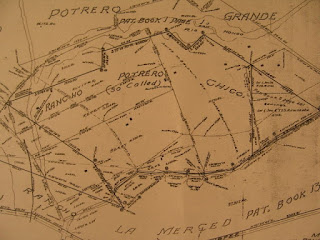
Just below this was a section that was inherited by Anastacio's sister, Maria de la Cruz. Although she was married in 1843 to José Ygnacio Cerradel, she had a later common-law relationship with Alessandro Repetto, a native of Genoa, Italy, who raised sheep on a ranch he owned in the hills of today's Monterey Park. In 1866, Maria de la Cruz gave birth to a son named Timoteo, who claimed his birthplace as the Rancho Potrero Chico, presumably on his mother's land.
In a parcel below Maria de la Cruz was one inherited by her sister, María Ventura, who was married to José Antonio Bermudez. Finally, there was about 6 acres held by another sibling, Micaela Alvitre. All four of these Alvitre tracts, owned by Anastacio, Cruz, Ventura, and Micaela, survived the the difficult years of the late 1850s and early 1860s, although Micaela did sell her tract to F. P. F. Temple in the early 1875.
Temple, Workman and Sanchez, however, experienced their own financial disaster, when the bank owned by the former two collapsed in 1876 due to poor management, bad investments, and a souring national and state economy. Desperate to save their institution, Temple and Workman took out a loan from San Francisco capitalist Elias J. "Lucky" Baldwin, putting down their many landholdings as collateral. Baldwin would not execute the loan without getting Sanchez to include his land in the deal. The loan failed to prevent the failure of the Temple and Workman bank and the three men were ruined. Subsequently, Baldwin foreclosed and took over the eastern portions of Potrero Chico deeded by the Valenzuela daughters and Vejar to Temple, Workman and Sanchez. After Baldwin's 1909 death, his daughters Anita Baldwin Stocker and Clara Baldwin became owners of these areas of the ranch.
Meantime, Temple had deeded the Micaela Alvitre tract shortly after he acquired it to Venancia Peña de Davis, who had been associated for years with Sanchez, and Mrs. Davis occupied it with her children. After Venancia died, her daughter Julia Davis de Cruz assumed ownership and resided on the property until her death in 1918. By 1930, a man named Stearns was said to have bought her land, shown as a little over 8 acres. As to the Ventura Alvitre de Bermudez tract, this soon passed to her daughter Adelaida (Elizabeth) Bermudez de Barry, who was married Irish-born George Barry. After the death of Cruz Alvitre in 1907, her tract went to her son, Timoteo Repetto, who had lived for years in Mexico and worked as a professional acrobat with his Mexican-born wife, Maria before moving in with his mother on her 16-acre spread in 1902. Finally, after Anastacio Alvitre died in the 1910s, his land went to son Pedro. Timoteo Repetto and Pedro Alvitre proved to be the last of the original ranch descendants to live on Potrero Chico, remaining there well after the 1940 census (as shown in the last post on this blog.)
Still, there was an essential problem. Despite the 1856-57 court judgments in favor of the Alvitre-Valenzuela land claim, no patent had been issued by the United States for Potrero Chico. There were also serious questions about the actual boundaries and acreage of the ranch and, as was often the case with Henry Hancock's work, the survey he did in 1858 was seriously questioned. Consequently, in 1920, the Joy Survey was conducted and came up with about 95 acres in total. This map was accepted by the California Surveyor General and the commissioner of the federal General Land Office. With a new survey on file, the heirs, presumably that of the Alvitre family, were able to request, finally, their government patent, which was dated 4 April 1923.
By 1923, some of their residents and heirs on Potrero Chico were leasing their properties for oil development, which had swept the area since the discovery of oil in the Montebello Hills several years prior. In many cases, prospecting was unsuccessful, in others there was moderate production, with the best wells generally being the hills or very close to them. In at least, possibly more, cases at Potrero Chico, there was at least some production, as Adelaida Bermudez de Barry and the estate of Julia Davis de Cruz (who died just weeks before oil drilling started on her land), in the southwestern sections closest to the hills, did receive at least some royalties.
In later years, though, oil or at least the potential of it seems to have driven the effort of the Valenzuela heirs to look into possible claims for the Potrero Chico lands they had once owned. The 1956 engineering report mentioned above was created to advance the Valenzuela family's assertion that they had been deprived, by bad surveying, other legal actions, and even an unsourced report of violence, of oil-bearing (or potentially so) lands that they were entitled to as descendants of one of the original ranch grantees.
A reading of the document, however, seems to show that the engineer was seeking to identify the location of the Potrero Chico ranch as being further west and south than the official maps show (basically over a reading of the original grant--the map of which is long gone--that indicates a reference to crests of hills that could have been the Montebello Hills to the southwest), including "covering" land owned by such successful oil leasors as Walter P. Temple (who was actually south of San Gabriel Boulevard) and William Prugh (whose land was on San Gabriel Boulevard, but near Darlington Avenue quite a distance north and west of Potrero Chico.) Moreover, the engineer, who did a great deal of research which is useful, also made some erroneous statements about deeds and grants.
One example is the claim that the 1853 deed from Valenzuela to Vejar was invalid because "having been made in 1853 over a year during which period the Mexicans could retain their old citizenship after the Treaty of Guadalupe Hidalgo was ratified, the transfer would clearly come under American Law . . . which would bar further action." The problem with this interpretation is simply that the treaty guaranteed that citizens of Mexican California would automatically receive American citizenship with the transfer of California to the U. S. unless they elected otherwise within five years. There is no evidence that Valenzuela elected to forego American citizenship and remain only a Mexican citizen and if he did nothing, he was automatically an American citizen and, therefore, entirely capable of issuing deeds.
In any case, it is hard to get around the fact that, in 1863, Salome and Siriaca Valenzuela, with their husbands, sold their interest in Potrero Chico to Workman, Temple and Sanchez and that there were many owners, residents and users of the land over the following 90 years. In addition, the surveying clearly was a mess (as the examples of maps shows above does demonstrate), but the assertion that the ranch boundaries would be so much further west and south is based on reading very vague statements made in the 1840s and then from witness statements from Valenzuela descendants who were not alive when the original grant was made.
Notably, one of them said that Valenzuela asked for land in the Montebello Hills (where valuable oil wells were located--some still operating today, though not for long) because he wanted to raise potatoes on them where it was drier than the land near the Rio Hondo. Yet, how would raising potatoes have been conducted on rocky hilly slopes with little soil in which to plant and no easily obtainable water supply for irrigating? If that were the case, than owners over the following decades, including Temple, Sanchez and Baldwin, would have been able to have farmed the hills before oil was found in 1917--but the hills apparently were only used for grazing animals.
Rancho Potrero Chico, though one of the smallest ranchos found in the Spanish and Mexican eras of California, is significant. Home for thousands of years to Gabrieleño Indians whose village of Isanthcag-na was located in the area, the rancho also has an important connection to the first European settlement in Los Angeles County, the Mission San Gabriel. Granted to descendants of early Spanish-era immigrants to California in the Alvitre and Valenzuela families, the rancho was occupied, ranched and farmed for a few generations with much of its parcels sold and deeded to others over the decades. The oil industry coming in after 1917 transformed the rancho and, after World War II, the creation of the Whittier Narrows flood control district also meant great changes as residential use was banned.
Finally, the Bosque de Rio Hondo park opened at the northwest corner of Rosemead and San Gabriel boulevards and part of it may (depending on whether surveys are believed!) be within the rancho, while other sections have commercial, government and recreational use in and around Whittier Narrows Regional Park.
Although the secularization of the missions took place in the mid-1830s, it was about a decade before the ranchos at Old Mission were granted. The smallest, but the most historically significant, was Rancho Potrero Chico known also as Potrero de la Misión Vieja de San Gabriel.
A potrero is pasture land, so with the well-watered lowlands around the Rio Hondo (the old channel of the San Gabriel River) being so desirable for the maintaining of cattle, it is easy to see why the three ranchos named as potreros were of interest to potential grantees.
Basically, the Potrero Chico lies north of San Gabriel Boulevard and Durfee Avenue and is bisected by Rosemead Boulevard, with more of the ranch to the east of the latter road than to the west. To the north is Legg Lake and the Whittier Narrows Regional Park. While this is not entirely clear, it does appear as if the Alvitres took the western portion of the small ranch, while the Valenzuelas occupied the eastern section. The reasons for this assumption are below.
As to the original grantees, Juan José Alvitre was born on 30 August 1798 in Los Angeles. His mother, María Rufina Hernandez was a native of the presidio of Loreto in Baja California. His father, Sebastian Alvtire, was born in Villa de Sinaloa in the state of Sinaloa, Mexico. A soldier in the Spanish army of New Spain (Mexico), Alvtire married Rufina at Loreto. He was one of the soldados del cuero (leather jackets) who were the military guard for the first European land exploration of California, the Portolá Expedition of 1769-1770. He was, then, present when the expedition stopped at the San Gabriel River (which Portolá called San Miguel) and camped. Father Juan Crespí, another member of the expedition who was scouting potential mission sites, found this area to be excellent for a mission, though considered the area now known as La Puente to be superior.
Five years after that, the grant to Potrero Chico was made and the Alvitres resettled. The couple appeared in the 1850 federal census, actually taken in early 1851 because California's statehood did not become official until September 1850, but they do not appear in the 1860 enumeration, so they evidently died in the interim.
The other grantee, José Antonio Valenzuela, was the brother-in-law of Juan José Alvitre, being married to Juan's younger sister, Maria Dominga Alvitre, who was born in Los Angeles in 1805. Valenzuela was almost a decade older than his wife, being born in 1796. His father, Jose Manuel, was, like Sebastian Alvitre from Villa de Sinaloa, Sinaloa, Mexico and came to California for the 1781 expedition to Mission San Gabriel, which would evidently been the same that brought the original 44 pobladores to found the new pueblo of Los Angeles. José Antonio and María Dominga had five children, including three sons and two daughters. She passed away in 1853 and he followed a decade later.
![]() |
| Another 1920s era map that seems to show the Cruz, Barry, Repetto and Alvitre sections as clearly within the boundaries of Rancho Potrero Chico. This is getting confusing! |
Alvitre and Valenzuela filed their land claim on 23 October 1852 when the commission held sessions in Los Angeles. A little more than a year later, on 13 December 1853, the commission ruled in favor of the claimants, but, as noted above, the inevitable appeal by the feds was filed. Two hearings before the Los Angeles federal district court were held in late January and early March 1856 and, again, Alvitre and Valenzuela, were successful. Another year passed by and, in late February 1857, the district court officially dismissed a federal appeal. Believing, evidently, that their grant was fully confirmed, the owners had a survey drawn up by county surveyor Henry Hancock in 1858, which gave the acreage as 100.07, although a 1956 engineering report submitted by Valenzuela heirs stated that Hancock recorded 96 acres, divided into two even sections of 48--presumably one for each family, with Alvitre to the west and Valenzuela to the east (as noted above.) This report also gives 1850s tax figures showing that the two men were assessed for 48 acres each.
Within a few years, however, both Alvitre and Valenzuela were dead and a number of issues developed that greatly changed the situation at Potrero Chico. First, although the 1858 survey was filed, there was no delivery of the patent by the federal government nor was any effort by heirs to seek one made. In addition, whatever income might have been made from the ranch, whether by farming and cattle grazing, the economy in the United States generally and in California and the Los Angeles area specifically soured in the late 1850s as a national depression erupted in 1857 and the end of the Gold Rush took place in the state. Then, in the winter of 1861-62, enormous flooding took place that ravaged the area, especially the Potrero Chico situated within the Whittier Narrows, where torrents of water from the San Gabriel (then called the Sierra Madre) Mountains rushed south toward the ocean. Once the area dried out, a two-year drought ensued that brought further devastation to farmers and ranchers.
It is not surprising then to find that two of Valenzuela's daughters decided to sell their inherited lands, probably because of the severe economic depression that existed in the early to mid 1860s. In early March 1863, just after their father José Antonio Valenzuela's death, Salome and her husband Lauriano García and Siriaca and her husband Francisco Duarte deeded their inheritance, which was not specified in acres, to William Workman, F. P. F. Temple and Juan Matias Sánchez. These three men were the wealthiest land owners in the general area. Workman, who owned half of the enormous Rancho La Puente to the east had obtained the Rancho La Merced, immediately south of Potrero Chico in 1850 by foreclosure against its grantee, Casilda Soto de [Villa]Lobo and gave that ranch to his son-in-law, Temple and his La Puente mayordomo (foreman), Sanchez. Over several years, during the depressed economic period of 1857 to 1863, the three began acquiring ranch lands in the Misión Vieja area, including portions of Potrero Chico.
Notably, the sale price was only $1, which suggests that Workman, Temple and Sanchez had perhaps loaned money to the sisters or, more likely, to their father or that there was some other consideration that would lead the Valenzuela women and their husbands to transfer the property for literally nothing. Also of interest is that the land described was "known by the name of Potrero en media de Potrero Chico originally granted to Antonio Valenzuela and Juan Alvitre." The italicized name indicates that this was half of the overall Potrero Chico consisting of separate pasture lands--in other words, this would be what Valenzuela had separate from Alvitre.
Meantime, another portion of Potrero Chico was sold a few weeks later, in early May 1863. This was a tract, described as in the northeast portion of the ranch and measuring 350x250 varas in extent. This is about 15 acres or so. This tract had been sold in March 1853 by Antonio Valenzuela to Francisco Vejar, of the well-known family that owned much of present today Pomona, and Vejar was assessed for 1850s taxes on 13 acres. Vejar, in turn, appointed his son Juan to be his "attorney in fact," handling the sale of this parcel to Workman, Temple and Sanchez. This was another $1 deed, but the reason for it is also not known.
Just below this was a section that was inherited by Anastacio's sister, Maria de la Cruz. Although she was married in 1843 to José Ygnacio Cerradel, she had a later common-law relationship with Alessandro Repetto, a native of Genoa, Italy, who raised sheep on a ranch he owned in the hills of today's Monterey Park. In 1866, Maria de la Cruz gave birth to a son named Timoteo, who claimed his birthplace as the Rancho Potrero Chico, presumably on his mother's land.
In a parcel below Maria de la Cruz was one inherited by her sister, María Ventura, who was married to José Antonio Bermudez. Finally, there was about 6 acres held by another sibling, Micaela Alvitre. All four of these Alvitre tracts, owned by Anastacio, Cruz, Ventura, and Micaela, survived the the difficult years of the late 1850s and early 1860s, although Micaela did sell her tract to F. P. F. Temple in the early 1875.
Temple, Workman and Sanchez, however, experienced their own financial disaster, when the bank owned by the former two collapsed in 1876 due to poor management, bad investments, and a souring national and state economy. Desperate to save their institution, Temple and Workman took out a loan from San Francisco capitalist Elias J. "Lucky" Baldwin, putting down their many landholdings as collateral. Baldwin would not execute the loan without getting Sanchez to include his land in the deal. The loan failed to prevent the failure of the Temple and Workman bank and the three men were ruined. Subsequently, Baldwin foreclosed and took over the eastern portions of Potrero Chico deeded by the Valenzuela daughters and Vejar to Temple, Workman and Sanchez. After Baldwin's 1909 death, his daughters Anita Baldwin Stocker and Clara Baldwin became owners of these areas of the ranch.
Meantime, Temple had deeded the Micaela Alvitre tract shortly after he acquired it to Venancia Peña de Davis, who had been associated for years with Sanchez, and Mrs. Davis occupied it with her children. After Venancia died, her daughter Julia Davis de Cruz assumed ownership and resided on the property until her death in 1918. By 1930, a man named Stearns was said to have bought her land, shown as a little over 8 acres. As to the Ventura Alvitre de Bermudez tract, this soon passed to her daughter Adelaida (Elizabeth) Bermudez de Barry, who was married Irish-born George Barry. After the death of Cruz Alvitre in 1907, her tract went to her son, Timoteo Repetto, who had lived for years in Mexico and worked as a professional acrobat with his Mexican-born wife, Maria before moving in with his mother on her 16-acre spread in 1902. Finally, after Anastacio Alvitre died in the 1910s, his land went to son Pedro. Timoteo Repetto and Pedro Alvitre proved to be the last of the original ranch descendants to live on Potrero Chico, remaining there well after the 1940 census (as shown in the last post on this blog.)
Still, there was an essential problem. Despite the 1856-57 court judgments in favor of the Alvitre-Valenzuela land claim, no patent had been issued by the United States for Potrero Chico. There were also serious questions about the actual boundaries and acreage of the ranch and, as was often the case with Henry Hancock's work, the survey he did in 1858 was seriously questioned. Consequently, in 1920, the Joy Survey was conducted and came up with about 95 acres in total. This map was accepted by the California Surveyor General and the commissioner of the federal General Land Office. With a new survey on file, the heirs, presumably that of the Alvitre family, were able to request, finally, their government patent, which was dated 4 April 1923.
By 1923, some of their residents and heirs on Potrero Chico were leasing their properties for oil development, which had swept the area since the discovery of oil in the Montebello Hills several years prior. In many cases, prospecting was unsuccessful, in others there was moderate production, with the best wells generally being the hills or very close to them. In at least, possibly more, cases at Potrero Chico, there was at least some production, as Adelaida Bermudez de Barry and the estate of Julia Davis de Cruz (who died just weeks before oil drilling started on her land), in the southwestern sections closest to the hills, did receive at least some royalties.
In later years, though, oil or at least the potential of it seems to have driven the effort of the Valenzuela heirs to look into possible claims for the Potrero Chico lands they had once owned. The 1956 engineering report mentioned above was created to advance the Valenzuela family's assertion that they had been deprived, by bad surveying, other legal actions, and even an unsourced report of violence, of oil-bearing (or potentially so) lands that they were entitled to as descendants of one of the original ranch grantees.
A reading of the document, however, seems to show that the engineer was seeking to identify the location of the Potrero Chico ranch as being further west and south than the official maps show (basically over a reading of the original grant--the map of which is long gone--that indicates a reference to crests of hills that could have been the Montebello Hills to the southwest), including "covering" land owned by such successful oil leasors as Walter P. Temple (who was actually south of San Gabriel Boulevard) and William Prugh (whose land was on San Gabriel Boulevard, but near Darlington Avenue quite a distance north and west of Potrero Chico.) Moreover, the engineer, who did a great deal of research which is useful, also made some erroneous statements about deeds and grants.
One example is the claim that the 1853 deed from Valenzuela to Vejar was invalid because "having been made in 1853 over a year during which period the Mexicans could retain their old citizenship after the Treaty of Guadalupe Hidalgo was ratified, the transfer would clearly come under American Law . . . which would bar further action." The problem with this interpretation is simply that the treaty guaranteed that citizens of Mexican California would automatically receive American citizenship with the transfer of California to the U. S. unless they elected otherwise within five years. There is no evidence that Valenzuela elected to forego American citizenship and remain only a Mexican citizen and if he did nothing, he was automatically an American citizen and, therefore, entirely capable of issuing deeds.
In any case, it is hard to get around the fact that, in 1863, Salome and Siriaca Valenzuela, with their husbands, sold their interest in Potrero Chico to Workman, Temple and Sanchez and that there were many owners, residents and users of the land over the following 90 years. In addition, the surveying clearly was a mess (as the examples of maps shows above does demonstrate), but the assertion that the ranch boundaries would be so much further west and south is based on reading very vague statements made in the 1840s and then from witness statements from Valenzuela descendants who were not alive when the original grant was made.
Notably, one of them said that Valenzuela asked for land in the Montebello Hills (where valuable oil wells were located--some still operating today, though not for long) because he wanted to raise potatoes on them where it was drier than the land near the Rio Hondo. Yet, how would raising potatoes have been conducted on rocky hilly slopes with little soil in which to plant and no easily obtainable water supply for irrigating? If that were the case, than owners over the following decades, including Temple, Sanchez and Baldwin, would have been able to have farmed the hills before oil was found in 1917--but the hills apparently were only used for grazing animals.
Rancho Potrero Chico, though one of the smallest ranchos found in the Spanish and Mexican eras of California, is significant. Home for thousands of years to Gabrieleño Indians whose village of Isanthcag-na was located in the area, the rancho also has an important connection to the first European settlement in Los Angeles County, the Mission San Gabriel. Granted to descendants of early Spanish-era immigrants to California in the Alvitre and Valenzuela families, the rancho was occupied, ranched and farmed for a few generations with much of its parcels sold and deeded to others over the decades. The oil industry coming in after 1917 transformed the rancho and, after World War II, the creation of the Whittier Narrows flood control district also meant great changes as residential use was banned.
Finally, the Bosque de Rio Hondo park opened at the northwest corner of Rosemead and San Gabriel boulevards and part of it may (depending on whether surveys are believed!) be within the rancho, while other sections have commercial, government and recreational use in and around Whittier Narrows Regional Park.
Tuesday, April 17, 2012
Misión Vieja and the 1940 Federal Census
A couple of weeks ago, the 1940 Federal Census was made publicly available by the National Archives. Censuses are released for general use 72 years after they were taken, so this latest enumeration allows us to see what was happening in our country at the tail end of the Great Depression and just before the United States entered World War II.
There were some notable changes to this census compared to previous ones. For example, the educational levels of citizens were recorded. Another addition is that residents were asked if they were living in the same household or, if not, where they had lived five years prior, in 1935. The census also asked for more specifics about employment, including number of weeks worked and earned income for the year 1939. With both the living arrangements since 1935 and the employment questions, the Census Bureau clearly wanted to see the effects of the Depression on Americans.
At Old Mission, changes continued to occur as the use of land in the area changed. On 13 April, census taker Robert West traveled down Rosemead Boulevard from Loma Avenue in what is now South El Monte and began his count within the area that is generally Misión Vieja. Notably, most of those persons counted remained in the same household they had been in during 1935. Of the thirty households that he found, only five, however, owned their houses, the rest being renters. Some of this was attributable to employees of oil and gas companies that had leases or, perhaps, owned the land they were prospecting. In some cases, residents might have been tenants of absentee landlords.
The first family was a rare one of propertyowners, this being Lorenzo Garcia, a 40-year old widower from Mexico, who lived with his four daughters and one son, all born in California. The Garcias had been in the same house in 1935, but, while Lorenzo was out of work, he had two daughters, Conchita and Isabelle, who were working as private family servants. As to education, Lorenzo studied up to the fourth grade, while his wife and two oldest daughters had some high school education.
Next to the Garcias was Severo and Micaela Ramirez, both 40, and their three sons and one daughter. While the parents were born in Mexico, their children were natives of California. This family had also resided in the same house five years prior and Severo worked as a road construction laborer, while one of his daughters was a student employee. Severo had a fourth-grade education, but his wife never went to school. The two youngest children were still in school, but the oldest, 19 and 18, left after the eighth grade.
Following were 88-year old Filomeno Alvarez, who lived with his 75-year old wife Virginia. Both were Mexican natives, had lived in the same house in 1935 and neither had ever attended school. At their age, of course, it is not surprising the neither had a listed occupation.
Then, there were the remaining members of the Alvitre family still living at Old Mission, where members of the family had resided for over 100 years. The patriarch was Pedro Alvitre, 75, who owned a modest home self-valued at $300. Pedro was listed as a farmer and had never been to school. He lived his 31-year old son, Angelo, and the young man's wife, Anita, age 26. Both of them had been to school through the sixth grade and Angelo was employed as a nurseryman. Living in a separate dwelling was Albert Alvitre, Pedro's son, who was residing with his wife Stella, 23, and their four young children, ranging from 2 months to 5 years old. Albert, who had been through two years of high school, was listed as head of a farm, perhaps superintending his father's spread, passed down for nearly a century on the old Rancho Potrero Chico, close to the original location of Mission San Gabriel, from its 1771 founding to about three years later when it moved to its current site. Finally, there was another son, Richard Alvitre, aged 30, his 20-year old wife Rebecca and their year-old son Rudolph. Richard had also completed two years of high school and, like his brother Angelo, worked in a nursery.
After a farming family was counted, named Varza by the census taker, but possibly named Garza, and headed by a 47-year old native of Mexico named Daniel and his wife Mary, who had three girls from 7 to 13 years old, the enumeration movdd to the other remaining "old timer" left from the early days of the Old Mission community. This was Pedro Alvitre's cousin, Timoteo Repetto. Aged 75, Repetto lived alone on some acreage that had been left to him through his mother, who was an Alvitre. He had a much nicer home than his cousin, however, judging from the $3000 value assigned to it. Shown also as a farmer, Timoteo was unusual with respect to his education, since he was shown as having attended two years of college, a rarity in the neighborhood.
The next household was that of Marcino and Isabella Serrano, natives of Mexico, who had three sons, a daughter and Mrs. Serrano's father, with them. Marcino, who did not receive any schooling, was a building construction laborer. Adjacent to them was another highly educated person, Mexican-born Juan Robles, age 45, who was a college graduate or at least had attended four years of higher education. Also different was his occupation: Robles was listed as "proprietor, fish pond." Evidently, he operated either a fish farm or, more likely a place where people could do a little fishing. In this general area is Legg Lake and maybe this was a predecessor of sorts. After Robles was the household of Pablo and Julia Amaro and Pablo's father, Amado, who was listed as 95 years old and would have been the oldest Old Mission resident. Pablo worked as a farmer and he and his wife had completed the eighth grade while Amado went only as far as the second. All of the people mentioned above had been residents of their households in 1935, except for Robles who had been living then in Los Angeles.
The next stop was the residence of Alva Andrus, a resident of the community since 1926, and a 49-year old native of Nebraska with an eighth-grade education. Andrus, living with his Indiana-born wife, Gayle, who only went to school through the fourth-grade, and their 14-year old son who was in eighth grade, did not have a job, though he'd been a laborer ten years before.
Following were two families who were connected. Archie McCoy, a 47-year old from New York, who'd been the college for a a year, lived his wife, two sons, and her father and McCoy was a oil company pumper. One of his sons, both of whom had some college education, was a car loader for an automobile company. Next to them was Nellie McCoy, presumably a sister-in-law of Archie's, and her son, Leo. The two had been in Anaheim in 1935, while Archie and his family were in the Old Mission community then. Leo was a truck driver for the "CCC," which stands for the California Conservation Corps, a New Deal program that is still around and doing important public works today. Another oil worker lived nearby, toolman Luther Grisham, a 38-year old from Illinois and his wife, two daughters and son--the Grishams had also been in the same house five years earlier.
The last two families listed on Rosemead Boulevard were that of building construction laborer Andrew Nunez, a 29-year old native of Mexico, his wife Ignacia, their two girls and one boy, and Nunez' fater Esteban or Steven and Joseph Lara, a 21-year old farmer and California native, residing with his wife, Mary, and their ten-month old daughter. Both Nunez, whose family had been in Los Angeles in 1935, and Lara, who was in the same house as five years before, had finished the eighth grade.
From here, enmerator West turned east and went up Durfee Avenue. His first family encountered was farm hand Eusebio Pérez, a 44-year old California native, his 23-year old wife, and two sons and a daughter, ranging from ages 12 to 18. Clearly Pérez had been married before and the children came from that first marriage. He had a sixth-grade education and two of his three children were in school, though the oldest, son Manuel, was also a farm worker. The family had been in their residence in 1935.
Two more oil-industry families followed. Truman Goodenough (these names usually pronounced Good-now) was an oil pumper and still working in a dangerous profession at age 69. The Pennsylvania native (this is where the American oil industry began in the late 1850s), who finished eighth grade, lived with his 57-year old wife, Mary. Next to them was an oil field foreman at only age 22, Robert Cain, who was a high school graduate and also from Pennsylvania and living with his 21-year old wife, Ruth, who a rare female worker, she being a typist for an insurance company. Both families had been in their houses in 1935.
Then, there was 48-year old Michigan-born Don Renwick, who migrated from Los Angeles within the last five years. Renwick, who had an eighth-grade education, was a foreman for a road construction crew, and he lived with his wife and namesake son.
The only Japanese family in the community was that of farmer Tokusuki Asato, age 63, and a widower and his three sons and one daughter, all born in California, and two of the sons working for their father. Asato had no education, but his two oldest sons had finished high school and his younger two were still in high school. The family was in the same residence they occupied in 1935.
Next to the Asatos were two additional oil workers, both working as pumpers on wells. These were 52-year old Edward Rush, a Tennessee-native with an eighth grade education and William Bugbee, a Canadian (as was his wife) who was still working at age 72. These men had also lived in their homes five years before.
West then counted families on Siphon Road, which still exists as a non-public roadway and which was historically an extension of San Gabriel Boulevard, being called in earlier days, Temple Road, for the prominent ranching family that once lived in the neighborhood. Here, on Siphon, was another aged worker, 74-year old Jesús Estrada, a native of California, who only went to school through the second grade and who was employed as a farm caretaker. He'd been in the same house the preceding half-decade, as well.
Of the several Italian families who had been in the community for several decades, one was Baptista Ciocca, a 65-year old native of the old country, living with his wife, also from Italy, and their two sons and two daughters. The Ciocca's were among the few homeowners, living in a $7000 residence, and also were distinguished by having three children who had been to college, with the youngest still in high school. Ciocca, as in 1930, had no listed occupation, evidently having enough money to be retired and was in the same house as in 1935.
Bernard Normann, listed as a farmer, but as a walnut grower in 1930, was living in a modest $1000 home that he owned along with his two sons in their early 20s. Normann, born in Illinois and aged 50, had an eighth grade education, but while his older son, a pipe factory worker, finished high school, his youngest was a rare college graduate and was working as a commercial artist. The Normann's obviously had not gone anywhere in the preceding five years.
The remaining five households were all renters. 27-year old California native Donald Farmer was not that, but, instead was a gas company crewman, who went as far as eighth grade in school. His Texan-born 18 year old wife, Thelma, completed two years of high school. Wilber Nutt was a poultry farmer and was a 25-year old California native, living with his wife Sybil, who was from Illinois and was a rare woman with some college education, probably junior college. The couple had a three year old daughter and, as with the Farmers, were living in the same residence as in 1935.
Two others on Siphon Road were 35-year old Jack Fickert, a Modesto, California transplant, who had one year of high school education and was employed as an oil well pumper. Next to him, was a 49-year old Oklahoma-born widow, Lilly Capehart, who had moved from her home state within the last five years and was a restaurant manager, though probably not in the Old Mission neighborhood.
Finally, the last family counted in the census in Misión Vieja was that of John Briano, whose father settled as a winemaker in the community during the 1890s. John, age 41 and a high school graduate, was running a retail liquor store and lived with his wife Freda and their three teenage children, one of whom was in college.
What the 1940 census shows is that the population of Old Mission was continuing to decline with there being just over 100 persons in the community. Many were farmers there, others worked on the remaining oil wells which were part of the Montebello Oil Fields, and some had jobs that took them outside their community. Within the next couple of decades, most of the community would be declared a flood zone by the federal government and the affected residents were forced to leave as the Whittier Narrows Dam was built. The 1950 census won't be available until 2022, so it will be quite a while until the next examination of the community can be made.
Contribution by Paul R. Spitzzeri, Assistant Director, Workman and Temple Family Homestead Museum, City of Industry, California.
There were some notable changes to this census compared to previous ones. For example, the educational levels of citizens were recorded. Another addition is that residents were asked if they were living in the same household or, if not, where they had lived five years prior, in 1935. The census also asked for more specifics about employment, including number of weeks worked and earned income for the year 1939. With both the living arrangements since 1935 and the employment questions, the Census Bureau clearly wanted to see the effects of the Depression on Americans.
At Old Mission, changes continued to occur as the use of land in the area changed. On 13 April, census taker Robert West traveled down Rosemead Boulevard from Loma Avenue in what is now South El Monte and began his count within the area that is generally Misión Vieja. Notably, most of those persons counted remained in the same household they had been in during 1935. Of the thirty households that he found, only five, however, owned their houses, the rest being renters. Some of this was attributable to employees of oil and gas companies that had leases or, perhaps, owned the land they were prospecting. In some cases, residents might have been tenants of absentee landlords.
The first family was a rare one of propertyowners, this being Lorenzo Garcia, a 40-year old widower from Mexico, who lived with his four daughters and one son, all born in California. The Garcias had been in the same house in 1935, but, while Lorenzo was out of work, he had two daughters, Conchita and Isabelle, who were working as private family servants. As to education, Lorenzo studied up to the fourth grade, while his wife and two oldest daughters had some high school education.
Next to the Garcias was Severo and Micaela Ramirez, both 40, and their three sons and one daughter. While the parents were born in Mexico, their children were natives of California. This family had also resided in the same house five years prior and Severo worked as a road construction laborer, while one of his daughters was a student employee. Severo had a fourth-grade education, but his wife never went to school. The two youngest children were still in school, but the oldest, 19 and 18, left after the eighth grade.
Following were 88-year old Filomeno Alvarez, who lived with his 75-year old wife Virginia. Both were Mexican natives, had lived in the same house in 1935 and neither had ever attended school. At their age, of course, it is not surprising the neither had a listed occupation.
Then, there were the remaining members of the Alvitre family still living at Old Mission, where members of the family had resided for over 100 years. The patriarch was Pedro Alvitre, 75, who owned a modest home self-valued at $300. Pedro was listed as a farmer and had never been to school. He lived his 31-year old son, Angelo, and the young man's wife, Anita, age 26. Both of them had been to school through the sixth grade and Angelo was employed as a nurseryman. Living in a separate dwelling was Albert Alvitre, Pedro's son, who was residing with his wife Stella, 23, and their four young children, ranging from 2 months to 5 years old. Albert, who had been through two years of high school, was listed as head of a farm, perhaps superintending his father's spread, passed down for nearly a century on the old Rancho Potrero Chico, close to the original location of Mission San Gabriel, from its 1771 founding to about three years later when it moved to its current site. Finally, there was another son, Richard Alvitre, aged 30, his 20-year old wife Rebecca and their year-old son Rudolph. Richard had also completed two years of high school and, like his brother Angelo, worked in a nursery.
After a farming family was counted, named Varza by the census taker, but possibly named Garza, and headed by a 47-year old native of Mexico named Daniel and his wife Mary, who had three girls from 7 to 13 years old, the enumeration movdd to the other remaining "old timer" left from the early days of the Old Mission community. This was Pedro Alvitre's cousin, Timoteo Repetto. Aged 75, Repetto lived alone on some acreage that had been left to him through his mother, who was an Alvitre. He had a much nicer home than his cousin, however, judging from the $3000 value assigned to it. Shown also as a farmer, Timoteo was unusual with respect to his education, since he was shown as having attended two years of college, a rarity in the neighborhood.
The next household was that of Marcino and Isabella Serrano, natives of Mexico, who had three sons, a daughter and Mrs. Serrano's father, with them. Marcino, who did not receive any schooling, was a building construction laborer. Adjacent to them was another highly educated person, Mexican-born Juan Robles, age 45, who was a college graduate or at least had attended four years of higher education. Also different was his occupation: Robles was listed as "proprietor, fish pond." Evidently, he operated either a fish farm or, more likely a place where people could do a little fishing. In this general area is Legg Lake and maybe this was a predecessor of sorts. After Robles was the household of Pablo and Julia Amaro and Pablo's father, Amado, who was listed as 95 years old and would have been the oldest Old Mission resident. Pablo worked as a farmer and he and his wife had completed the eighth grade while Amado went only as far as the second. All of the people mentioned above had been residents of their households in 1935, except for Robles who had been living then in Los Angeles.
The next stop was the residence of Alva Andrus, a resident of the community since 1926, and a 49-year old native of Nebraska with an eighth-grade education. Andrus, living with his Indiana-born wife, Gayle, who only went to school through the fourth-grade, and their 14-year old son who was in eighth grade, did not have a job, though he'd been a laborer ten years before.
Following were two families who were connected. Archie McCoy, a 47-year old from New York, who'd been the college for a a year, lived his wife, two sons, and her father and McCoy was a oil company pumper. One of his sons, both of whom had some college education, was a car loader for an automobile company. Next to them was Nellie McCoy, presumably a sister-in-law of Archie's, and her son, Leo. The two had been in Anaheim in 1935, while Archie and his family were in the Old Mission community then. Leo was a truck driver for the "CCC," which stands for the California Conservation Corps, a New Deal program that is still around and doing important public works today. Another oil worker lived nearby, toolman Luther Grisham, a 38-year old from Illinois and his wife, two daughters and son--the Grishams had also been in the same house five years earlier.
The last two families listed on Rosemead Boulevard were that of building construction laborer Andrew Nunez, a 29-year old native of Mexico, his wife Ignacia, their two girls and one boy, and Nunez' fater Esteban or Steven and Joseph Lara, a 21-year old farmer and California native, residing with his wife, Mary, and their ten-month old daughter. Both Nunez, whose family had been in Los Angeles in 1935, and Lara, who was in the same house as five years before, had finished the eighth grade.
From here, enmerator West turned east and went up Durfee Avenue. His first family encountered was farm hand Eusebio Pérez, a 44-year old California native, his 23-year old wife, and two sons and a daughter, ranging from ages 12 to 18. Clearly Pérez had been married before and the children came from that first marriage. He had a sixth-grade education and two of his three children were in school, though the oldest, son Manuel, was also a farm worker. The family had been in their residence in 1935.
Two more oil-industry families followed. Truman Goodenough (these names usually pronounced Good-now) was an oil pumper and still working in a dangerous profession at age 69. The Pennsylvania native (this is where the American oil industry began in the late 1850s), who finished eighth grade, lived with his 57-year old wife, Mary. Next to them was an oil field foreman at only age 22, Robert Cain, who was a high school graduate and also from Pennsylvania and living with his 21-year old wife, Ruth, who a rare female worker, she being a typist for an insurance company. Both families had been in their houses in 1935.
Then, there was 48-year old Michigan-born Don Renwick, who migrated from Los Angeles within the last five years. Renwick, who had an eighth-grade education, was a foreman for a road construction crew, and he lived with his wife and namesake son.
The only Japanese family in the community was that of farmer Tokusuki Asato, age 63, and a widower and his three sons and one daughter, all born in California, and two of the sons working for their father. Asato had no education, but his two oldest sons had finished high school and his younger two were still in high school. The family was in the same residence they occupied in 1935.
Next to the Asatos were two additional oil workers, both working as pumpers on wells. These were 52-year old Edward Rush, a Tennessee-native with an eighth grade education and William Bugbee, a Canadian (as was his wife) who was still working at age 72. These men had also lived in their homes five years before.
West then counted families on Siphon Road, which still exists as a non-public roadway and which was historically an extension of San Gabriel Boulevard, being called in earlier days, Temple Road, for the prominent ranching family that once lived in the neighborhood. Here, on Siphon, was another aged worker, 74-year old Jesús Estrada, a native of California, who only went to school through the second grade and who was employed as a farm caretaker. He'd been in the same house the preceding half-decade, as well.
Of the several Italian families who had been in the community for several decades, one was Baptista Ciocca, a 65-year old native of the old country, living with his wife, also from Italy, and their two sons and two daughters. The Ciocca's were among the few homeowners, living in a $7000 residence, and also were distinguished by having three children who had been to college, with the youngest still in high school. Ciocca, as in 1930, had no listed occupation, evidently having enough money to be retired and was in the same house as in 1935.
Bernard Normann, listed as a farmer, but as a walnut grower in 1930, was living in a modest $1000 home that he owned along with his two sons in their early 20s. Normann, born in Illinois and aged 50, had an eighth grade education, but while his older son, a pipe factory worker, finished high school, his youngest was a rare college graduate and was working as a commercial artist. The Normann's obviously had not gone anywhere in the preceding five years.
The remaining five households were all renters. 27-year old California native Donald Farmer was not that, but, instead was a gas company crewman, who went as far as eighth grade in school. His Texan-born 18 year old wife, Thelma, completed two years of high school. Wilber Nutt was a poultry farmer and was a 25-year old California native, living with his wife Sybil, who was from Illinois and was a rare woman with some college education, probably junior college. The couple had a three year old daughter and, as with the Farmers, were living in the same residence as in 1935.
Two others on Siphon Road were 35-year old Jack Fickert, a Modesto, California transplant, who had one year of high school education and was employed as an oil well pumper. Next to him, was a 49-year old Oklahoma-born widow, Lilly Capehart, who had moved from her home state within the last five years and was a restaurant manager, though probably not in the Old Mission neighborhood.
Finally, the last family counted in the census in Misión Vieja was that of John Briano, whose father settled as a winemaker in the community during the 1890s. John, age 41 and a high school graduate, was running a retail liquor store and lived with his wife Freda and their three teenage children, one of whom was in college.
What the 1940 census shows is that the population of Old Mission was continuing to decline with there being just over 100 persons in the community. Many were farmers there, others worked on the remaining oil wells which were part of the Montebello Oil Fields, and some had jobs that took them outside their community. Within the next couple of decades, most of the community would be declared a flood zone by the federal government and the affected residents were forced to leave as the Whittier Narrows Dam was built. The 1950 census won't be available until 2022, so it will be quite a while until the next examination of the community can be made.
Contribution by Paul R. Spitzzeri, Assistant Director, Workman and Temple Family Homestead Museum, City of Industry, California.
Labels:
Alvitre family,
Mision Vieja,
Old Mission,
Repetto family
Subscribe to:
Posts (Atom)


